How to Start A Microschool: 10 Questions to Ask Before You Open
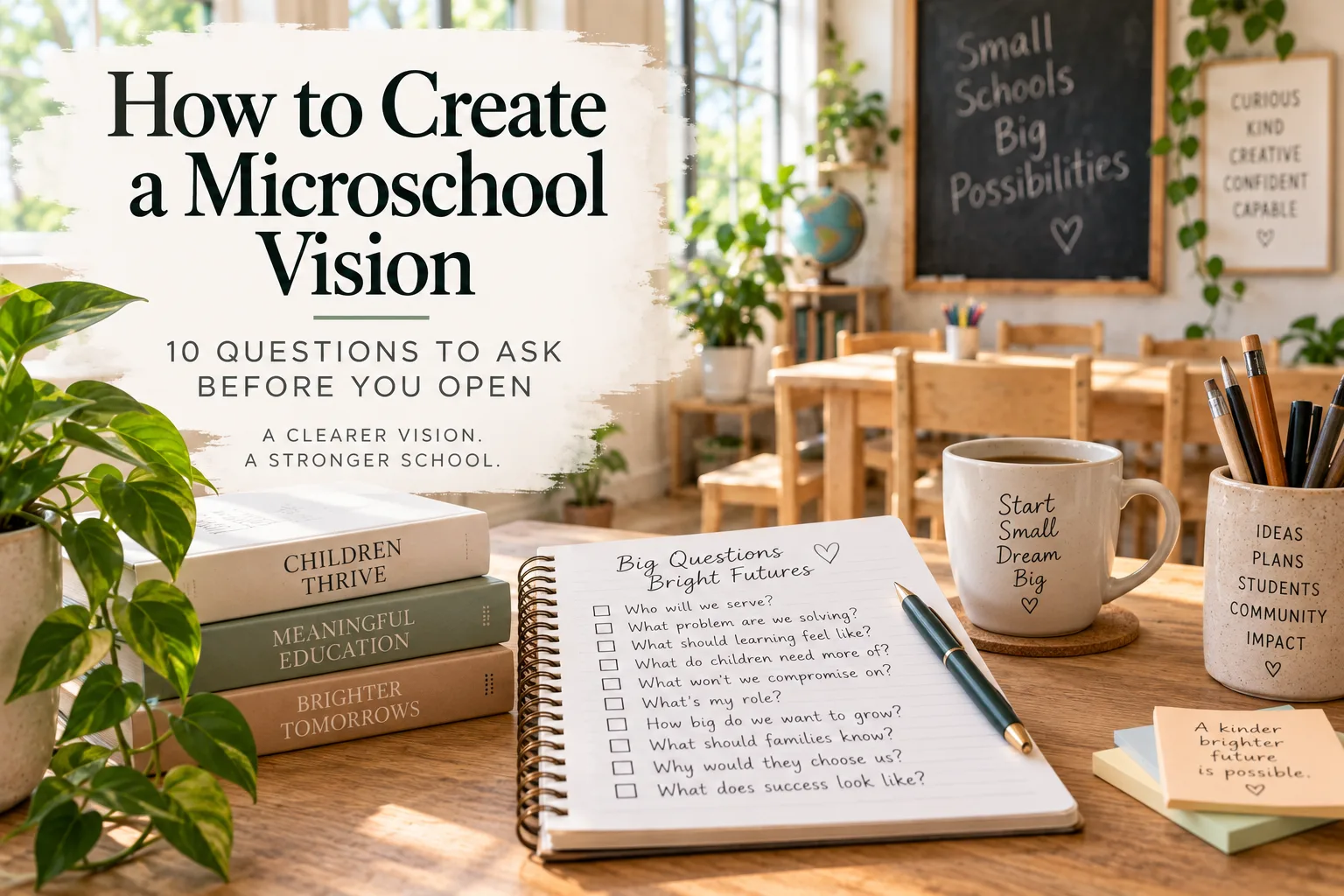
How to Create a Microschool Vision: 10 Questions to Ask Before You Open
When you're starting a microschool, it's tempting to jump straight into the tangible stuff.
Curriculum. A name. A logo. A building. A schedule.
But before you build the school, you need to know what you're actually trying to build.
Your vision doesn't need to be a beautifully written paragraph hanging on a wall. It needs to help you make decisions.
These 10 questions are a good place to start.
1. Who do you most want to serve?
Don't start with “K–8 students.”
Think about the actual children and families you picture walking through your doors.
Are they homeschool families looking for more community? Students who haven't thrived in traditional classrooms? Families looking for more flexibility? Kids who need more movement, creativity or individual attention?
The clearer you are about who you're serving, the easier almost every other decision becomes.
2. What problem are you solving for those families?
Families aren't looking for a microschool simply because the word microschool sounds interesting.
They're looking for something they aren't getting somewhere else.
What is that?
More individualized learning? Smaller classes? Flexibility? Community? A different educational philosophy? More time outdoors? Less pressure?
You don't have to solve every problem in education.
What problem does your school exist to solve?
3. What do you want learning to feel like?
Forget curriculum for a minute.
Picture a normal Tuesday morning in your future school.
What are the kids doing?
What does the room sound like?
How much are they moving? Talking? Creating? Working independently?
Are adults directing most of the learning, or are students?
Sometimes it's easier to define your educational philosophy by imagining the experience rather than trying to give it a label.
4. What do you believe children need that they aren't getting enough of?
This question gets right to the heart of your school.
Maybe your answer is:
- time
- play
- challenge
- independence
- belonging
- movement
- creativity
- individual attention
- real-world experiences
- meaningful relationships
Whatever your answer is, it should eventually show up in the way your school operates.
5. What are you unwilling to compromise on?
Every founder eventually gets requests.
Could you add another grade?
Could you stay open later?
Could you use this curriculum?
Could you take just a few more students?
Some requests will make your school better.
Others will slowly turn it into a school you never intended to build.
What are the things you want to protect—even as you grow?
6. What role do YOU actually want?
This one gets overlooked.
Do you want to teach every day?
Lead a team?
Spend most of your time with students?
Eventually step out of the classroom?
Run a tiny school yourself forever?
Build something that grows beyond you?
There isn't a correct answer.
But your school model should support the life and role you actually want—not just the school you think you're supposed to build.
7. How big do you actually want this school to become?
Six students can be a microschool.
So can 20.
So can a growing program with multiple guides and classrooms.
Don't automatically assume bigger = more successful.
Ask yourself what size allows you to deliver the experience you're imagining while also creating a financially sustainable school.
8. What should families understand before they enroll?
Think about the family who would absolutely love your school.
What do they understand about education, your approach and their role in the community?
Now think about the family who probably wouldn't be a good fit.
What's different?
Being clear about what your school is—and isn't can help the right families recognize themselves in what you're building.
9. Why would a family choose your school instead of another option?
This isn't about having a clever marketing slogan.
It's about understanding what genuinely makes your school different.
If a parent asked:
“Why should I send my child here?”
Could you answer in a sentence or two?
If not, keep working on it.
10. Three years from now, what would make you say, “This worked”?
Not just:
We enrolled a lot of students.
What would success actually look like?
Maybe you're financially sustainable.
Maybe you have a waitlist.
Maybe you're still happily teaching eight children around a big table.
Maybe you've hired your first teacher.
Maybe families tell you their children love learning again.
Maybe you've built a school that allows you to do meaningful work without burning yourself out.
Define success before someone else defines it for you.
You don't need every answer today.
But you should start asking the questions.
Because the strongest microschools aren't built by copying someone else's model.
They're built when founders get clear about who they want to serve, what they believe, and what kind of school they actually want to create.
If you're at the very beginning of the process, you may also want to read our [How to Start a Microschool: A Step-by-Step Guide for Future Founders](https://themicroschoollab.com/blog/how-to-start-a-microschool-7-steps-for-new-founders).
Ready to go deeper?
These 10 questions are only the beginning.
We created **25 Questions to Build a Stronger Microschool** to help you think through the decisions that will shape your school—from your vision and values to the experience you want to create for students and families.
And if you're looking for tools, resources and support as you turn those answers into an actual school, you can find us at The Microschool Lab.